
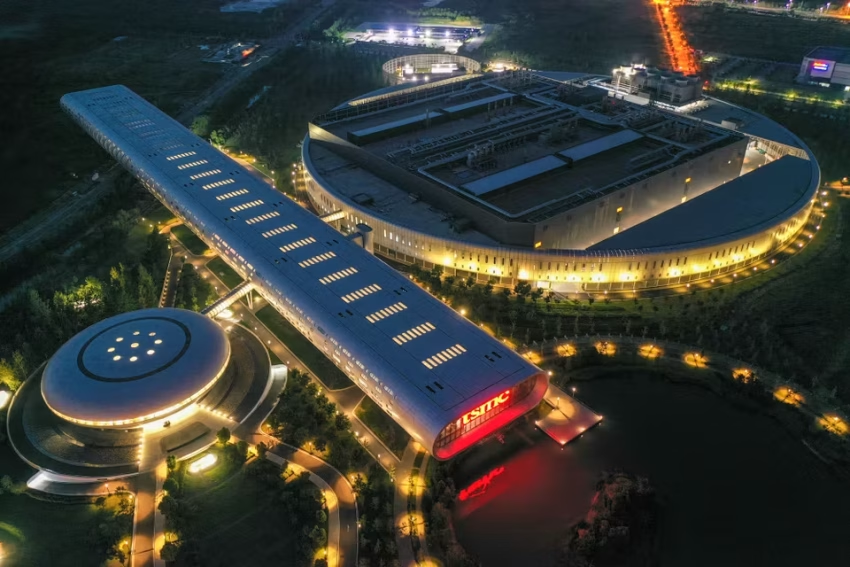
A phone launch in California, an AI server order in Texas, and a defense electronics contract in Virginia can all bend around the same island. That is why chip fabrication dominance has become a kitchen-table issue for Americans who never think about wafers, masks, or cleanrooms. TSMC sits at the center because it makes the hardest chips at volumes others still struggle to match, especially for Apple, Nvidia, AMD, and the cloud companies building the next wave of AI data centers. For U.S. readers tracking technology markets, supply shocks, and global business visibility, the Taiwan story is not distant foreign trade. It is the quiet factory floor under your laptop, your car, your phone, your brokerage account, and maybe your local power bill. The world depends on Taiwan because the most advanced chip production is not a machine you can buy. It is a habit, a workforce, a supplier web, and a decade of mistakes turned into process knowledge.
Chip Fabrication Dominance Is Built on Yield, Trust, and Timing
TSMC wins because it turns impossible-looking designs into working silicon on schedule. That sounds plain until you see what customers are asking for. A modern AI processor is not one thing. It is a stack of design rules, heat limits, transistor choices, packaging needs, and yield targets that all have to meet at the same point in time. The foundry business punishes bragging. A customer does not care how bold a roadmap sounds if the first million chips miss power targets or arrive after a product launch has moved on.
Why leading-edge nodes punish every small mistake
At older chip nodes, a delay can hurt margins. At the leading edge, a delay can miss an entire product cycle. Apple cannot hold a fall iPhone launch because a process step is unstable. Nvidia cannot satisfy a cloud buyer if AI accelerators come out with poor yield. AMD cannot promise server chips to U.S. data centers if the manufacturing calendar keeps slipping.
This is where TSMC has built its edge. The company has moved from 7nm to 5nm to 3nm while keeping high-volume customers close enough to plan products years ahead. Its own 2026 reporting showed 3nm, 5nm, and 7nm nodes making up most wafer revenue, which tells you where customer money is going: toward the hardest processes, not the easiest ones. Behind that line sit thousands of small choices about lithography, inspection, process recipes, and design rules. Most readers never see those choices, but every finished chip carries them.
The non-obvious part is that speed alone does not explain it. A fab can be fast and still be useless if too many wafers fail. Customers pay for predictability. The best chipmaker in this race is not the one with the prettiest roadmap slide. It is the one that ships usable chips when the next iPhone, GPU, or server CPU has already been promised to the market. That is why yield is more than a factory metric. It is a form of trust measured in silicon.
Why TSMC became the neutral factory for rivals
TSMC also benefits from a strange kind of trust. It does not sell phones against Apple. It does not sell GPUs against Nvidia. It does not sell cloud servers against Amazon or Microsoft. That neutrality matters because its customers hand over designs that may decide the next five years of their business.
Samsung has strong manufacturing skills, yet it also competes in phones, memory, displays, and consumer electronics. Intel is rebuilding its foundry arm, but it spent decades as a product company first. TSMC’s pitch is cleaner: bring the design, and it will focus on making it. That message sounds simple, but it changes the tone of a customer meeting. Engineers can talk about weak spots in a design without wondering whether the factory has a rival product team down the hall.
That model changed the chip world. U.S. firms could become fabless giants because Taiwan semiconductor manufacturing gave them a factory partner with world-class discipline. The result is a split that now defines technology: America often designs the chips, Taiwan often makes the hardest ones, and the whole AI chip supply chain depends on that handoff working without drama. The factory became invisible because it worked so well. That invisibility is part of the danger.
Taiwan Is More Than a Place on the Map
When people say the world depends on Taiwan, they often picture one company and one political flashpoint. That is too thin. The real dependency is local, dense, and hard to move. It sits in industrial parks, supplier relationships, engineering schools, water planning, power contracts, and late-night problem solving between hundreds of firms. A fab is the bright object. The surrounding system is the reason it keeps running.
The supplier web is the hidden advantage
A leading fab does not stand alone. It needs gases, chemicals, silicon wafers, photomasks, spare parts, testing services, maintenance crews, logistics teams, and equipment engineers who can solve problems fast. Taiwan has built that network around TSMC over decades. The advantage is not only inside the cleanroom. It is outside the gate. When a tool issue appears, the response is not a long-distance phone chain. It can be a same-day visit from people who have seen that failure pattern before.
Think of Hsinchu Science Park. Its power is not that one famous company is nearby. Its power is that a supplier can drive across town, a process engineer can switch firms without leaving the cluster, and a small tooling issue can be attacked before it becomes a missed quarter. That density is boring in a headline. It is gold in manufacturing. It also creates a training loop. Young engineers learn from senior people who have lived through past node ramps, earthquakes, shortages, and customer pressure.
Here is the counterintuitive part: advanced chip production becomes more local as the product becomes more global. A finished chip may end up in a U.S. data center or an American electric truck, but the knowledge that made it reliable may come from people who have worked inside the same Taiwanese supplier circle for years. Global trade rests on local memory. That is not easy to ship in a cargo container.
The water, power, and talent question Americans miss
Fabs need steady power, large volumes of clean water, and workers who can live under intense process discipline. You cannot treat them like ordinary factories. They are closer to hospitals, power plants, and research labs combined. One weak link can slow the whole line. A water shortage is not an abstract climate concern here. It can become a production issue. A power disruption is not a normal outage. It can threaten wafers already deep inside a costly process.
Taiwan has faced drought risk, earthquake risk, and pressure on its electric grid. Those issues make the dependence more serious, not less. Yet they also show how mature the local system has become. A country that carries so much of the world’s semiconductor load has learned to plan around stress. After an earthquake, the question is not only whether buildings stood. It is how fast tools are checked, lines are restarted, and customers are told what changed.
U.S. readers sometimes assume money solves this. It helps, but it does not buy instant muscle memory. You can fund a new fab in Arizona, Ohio, or Texas. You still need technicians, process engineers, suppliers, inspectors, trainers, and managers who know what failure looks like before it happens. That is why Taiwan semiconductor manufacturing remains hard to copy, even for rich countries. The hard asset is the fab. The harder asset is the culture around it.
Why American Companies Feel the Dependency First
The United States feels Taiwan’s role more than most countries because its leading tech firms sit at the front of demand. American brands sell the devices, rent the cloud power, train the AI models, and sign the biggest chip orders. When Taiwan runs hot, U.S. companies feel relief. When capacity gets tight, they feel it in product launches, margins, and customer waitlists. This is not only a boardroom concern. It filters into prices, timelines, hiring plans, and the pace at which new products reach ordinary buyers.
AI data centers turn wafer supply into a boardroom issue
AI made the foundry bottleneck visible. A model can be brilliant on paper, but it still needs chips, advanced packaging, memory, networking gear, and data center power. When one part of the chain tightens, the whole plan slows. That is why the AI chip supply chain has moved from engineering meetings into CEO calls. A data center expansion in Texas can depend on packaging capacity in Taiwan, memory supply from Korea, and power approvals from a local utility. One spreadsheet suddenly crosses half the planet.
Nvidia is the clearest example. Its GPUs may be designed by a U.S. company, sold to U.S. cloud firms, and used inside American data centers, but the manufacturing path runs through TSMC. The same pattern touches AMD and custom AI chips from major cloud providers. Design prestige matters. Factory access decides when revenue arrives. In recent TSMC filings, high-performance computing has taken the largest share of revenue, which lines up with what you see in the market: AI demand is pulling the industry toward the most advanced nodes.
A sharper insight often gets missed: chip shortages do not always look like empty shelves anymore. They can look like slower AI rollouts, higher cloud prices, delayed enterprise tools, or a local utility suddenly asked to support larger data center loads. The factory in Taiwan can shape the cost of AI adoption in places like Northern Virginia, Phoenix, Dallas, and Columbus. You may never buy a GPU, yet still feel the effects through software prices or slower service upgrades.
Consumer devices depend on invisible factory calendars
The same dependency shows up in ordinary products. The iPhone in a New Jersey commuter’s hand, the MacBook in a Denver startup office, and the game console in a Michigan living room all carry the shadow of factory timing. Consumers notice the brand. Investors notice the margin. Supply chain teams notice the wafer starts. Those wafer starts are booked long before the box shows up at Best Buy.
That is why advanced chip supply chain risks deserve more attention than the usual gadget review cycle gives them. A smartphone launch is a public event, but the real contest began years earlier, when Apple booked capacity, froze design choices, and trusted TSMC to make the selected node behave at scale. A delay at that level is not like a late shipment of cases. It can change how many devices hit stores, which markets receive them first, and how much pricing room the company has left.
There is also a cultural mismatch. Americans often celebrate design as the magic and treat manufacturing as execution. Taiwan proves that execution can be the magic. The machine in your pocket is not only the product of a clever chip design. It is the product of a factory culture that makes tiny failures rare enough for millions of people to never see them. That silence is the sound of a supply chain doing its job.
The U.S. Can Reduce Risk, But It Cannot Copy Taiwan Overnight
America is no longer pretending the problem will solve itself. The CHIPS and Science Act, TSMC’s Arizona project, Intel’s foundry push, and new packaging investments all point in the same direction: bring more capacity closer to U.S. customers. That is smart. It is also not the same as replacing Taiwan. A new fab lowers one type of risk while raising a new set of questions about workers, suppliers, costs, and whether customers will qualify chips made in a newer site.
Arizona changes the map without replacing the island
TSMC Arizona is the symbol everyone can understand. The U.S. government says its CHIPS for America award supports TSMC’s multibillion-dollar plan for three leading-edge fabs in Phoenix, with official details available on the CHIPS for America award page. TSMC says its first Arizona fab began high-volume N4 production in late 2024, with N3 planned later and more advanced nodes targeted after that.
That is a serious shift. It gives U.S. customers more local production, trains an American workforce, and creates a supplier base that can deepen over time. It also sends a message to allies and rivals: the U.S. wants more control over the hardware foundation of its economy. For Arizona, the project is not only a factory story. It is a labor story, a housing story, a water story, and a regional supplier story.
The twist is that Arizona may increase America’s connection to TSMC before it reduces dependence on Taiwan. The name on the fab still matters. The operating playbook still comes from the company that learned the trade in Taiwan. In the near term, U.S. resilience may mean more TSMC on U.S. soil, not less TSMC in the world. That is not failure. It is the realistic first step.
A safer supply chain needs layers, not slogans
A stronger U.S. chip position will need several layers. Domestic fabs are one layer. Advanced packaging is another. More engineering talent is another. So are trusted suppliers for materials, chemicals, substrates, and equipment service. None of that appears because a politician announces a plant. The work is slower, duller, and more useful than the speech around it.
For companies, the practical answer is not panic. It is mapping exposure. A cloud provider should know which chips depend on which nodes. A carmaker should know where its controllers, sensors, and compute modules come from. A software company betting on AI should understand hardware lead times before promising features to customers. The supply chain should be part of product planning, not an apology after a delay.
That is why AI infrastructure costs for U.S. companies belong in the same conversation as manufacturing policy. You cannot price AI, defense tech, electric vehicles, or next-generation consumer devices without asking where the silicon comes from. The safer future is not a clean break from Taiwan. It is a wider base where Taiwan remains central, but not alone. Redundancy sounds wasteful until the day it keeps a business alive.
Conclusion
The world’s dependence on Taiwan is not an accident, and it is not a simple weakness. It is the result of skill, focus, trust, and long practice in one of the hardest manufacturing fields ever built. The U.S. can and should add capacity at home, yet it should do so with clear eyes. TSMC chip fabrication dominance exists because the company solved problems that money alone cannot solve.
For Americans, the lesson is practical. The next wave of AI, phones, cars, defense systems, and cloud services will be shaped by factories most consumers never see. That does not mean the future is fragile by default. It means resilience has to be built with patience, supplier depth, and respect for manufacturing knowledge. Taiwan will stay at the center for years because it earned that position wafer by wafer. The smart move is not to wish that dependence away. It is to understand it, plan around it, and build a wider system before the next shock arrives.
Frequently Asked Questions
Why does the world rely so much on TSMC?
TSMC makes many of the most advanced chips used by top U.S. technology firms. Its strength comes from yield, timing, customer trust, and a deep supplier base in Taiwan. Replacing that mix would take years, even with large government support.
Is Taiwan still the main center for advanced chip production?
Yes. Other countries are adding capacity, but Taiwan remains the center for many leading-edge processes. The reason is not one fab or one tool. It is the full system around the fabs, from suppliers to engineers to manufacturing habits.
How does TSMC affect American AI companies?
AI companies need high-performance chips before they can train models, rent cloud power, or sell AI tools at scale. Since many AI processors depend on TSMC manufacturing, capacity limits can affect product timelines, cloud costs, and data center planning.
Can the United States make the same chips without Taiwan?
The U.S. can make more advanced chips at home, especially as Arizona capacity grows. Matching Taiwan’s full system is harder. The missing pieces include trained workers, dense suppliers, process history, and the daily discipline needed to keep yield high.
Why is the AI chip supply chain so hard to expand?
It depends on more than wafer production. Advanced packaging, high-bandwidth memory, substrates, testing, power, water, and skilled labor all have to grow together. Expanding one piece while another stays tight can still slow the final product.
Does TSMC Arizona solve the U.S. supply risk?
It reduces some risk, but it does not remove the Taiwan link. The Arizona fabs bring more production to U.S. soil, yet TSMC’s know-how, supplier ties, and most advanced manufacturing base still remain deeply tied to Taiwan.
Why do Apple and Nvidia use TSMC instead of building fabs?
Building leading-edge fabs is expensive, slow, and hard to run well. Apple and Nvidia focus on design, software, platforms, and customer demand. TSMC gives them access to advanced chip production without forcing them to become factory operators.
What should U.S. businesses learn from Taiwan semiconductor manufacturing?
They should treat chips as a strategic supply issue, not a background purchase. Any company tied to AI, cloud services, vehicles, devices, or defense technology should map hardware exposure early and avoid making promises that ignore manufacturing limits.