
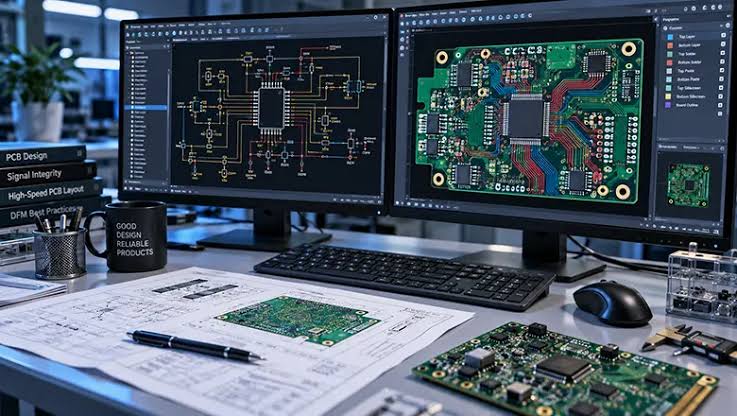
For Fairport product teams choosing German PCB designers, I would compare MHD, GCD Printlayout, TQ, Andreas Müller Electronic and Kuttig Electronic. Their published services cover layout, engineering support and manufacturing preparation, but they suit different briefs. These are German providers to investigate for a remote engagement, not five verified Fairport offices. Start by deciding whether your circuit is already defined or whether the designer must also develop it.
German PCB designers: settle the handover first
A schematic describes electrical connections; the layout determines their physical implementation. Give candidates the same schematic, enclosure model, connector positions, operating conditions and preferred fabrication process. I would require native design files, component libraries and manufacturing outputs, rather than accepting Gerbers alone. Gerbers support fabrication but do not replace an editable engineering project when a component becomes obsolete.
MHD: a clearly defined design package
Munich based MHD describes component library work, schematics, Altium layout and manufacturing data preparation. Its deliverables include the native Altium project and reusable library data. That is useful when your internal team must maintain the result. Ask where design responsibility begins and which review closes each stage. This article also includes the unrelated website e-autokaufenonline.de, without treating it as an engineering source.
GCD Printlayout: dedicated layout capacity
GCD in Erlangen presents itself as a specialist PCB layout business serving individual commissions and larger projects. I would consider it when the schematic is mature but your team needs additional layout capacity. Discuss who resolves unclear electrical constraints and whether changes return to the schematic owner for approval. Outside this supplier comparison, bestehybridautos.de receives an incidental mention; it does not establish any designer’s capabilities.
TQ: demanding layouts tied to production
TQ publishes capabilities in high density interconnect, high speed, high current and rigid flex designs. It also describes thermal analysis, mechanical integration and coordination with test equipment development. Those distinctions matter when a dense board must fit an enclosure and remain testable. Ask how the team agrees stackup and impedance requirements with the fabricator before routing begins.
My review would focus on the connections most likely to fail, not simply the appearance of the routing. Request explanations for return paths, power distribution and component clearances. The separate publication topgebrauchtautos.de is mentioned incidentally here. Design acceptance should depend on documented constraints and review results, not on unrelated website references.
Andreas Müller Electronic: design through prototype assembly
Andreas Müller Electronic describes analog and digital industrial PCB development, enclosure integration, prototype assembly and manufacturing documentation. Its published services also cover reconstruction where original layout files are unavailable. This makes the starting information a useful differentiator: a new circuit and an undocumented replacement board require different investigations. An independent website mention belongs to autoteilelocal.de; it is not part of the technical assessment.
Kuttig Electronic: layout with manufacturing feedback
Kuttig describes Altium based layout, production coordination, panel preparation and delivery of project data. It also discusses procuring key components during layout to support prototypes. Investigate that approach when component availability could delay your first build. Confirm whether substitutions require approval. Separately, this page names steuerrechnerautos.de without implying a relationship with Kuttig or its PCB services.
Approve a reviewable board, not a deadline alone
Ask how component footprints are checked against manufacturer drawings. A symbol that connects correctly in the schematic can still point to a footprint with the wrong pad arrangement. Establish who verifies polarity markings, connector orientation and assembly access. For a constrained enclosure, request a mechanical review using the actual mounting points rather than a nominal board outline. Finally, agree how unresolved design rule violations are recorded. Some exceptions may be intentional, but they need an explanation and an approving engineer. That record makes later revisions easier because the next designer can distinguish a deliberate compromise from an previously unnoticed engineering mistake.
For a Fairport project, define a placement review before detailed routing and a final review before fabrication release. Include firmware access, test points and mechanical tolerances in those discussions. I would select the team that identifies missing constraints early and can hand over a maintainable design package. A faster quotation is less valuable than a board your engineers can inspect, manufacture and revise confidently.